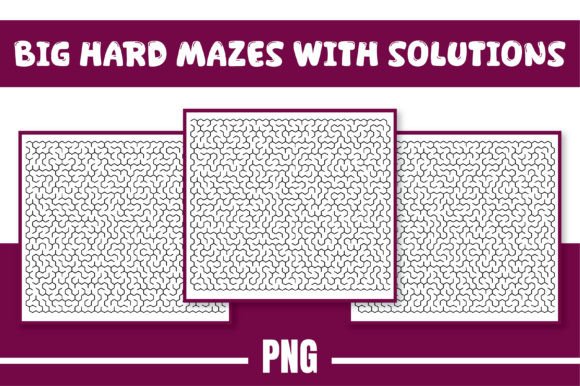
Big Hard Hexagonal Mazes with Solutions
Hexagonal mazes aren’t just a twist on tradition—they’re a deliberate step up in spatial reasoning, visual processing, and sustained focus. Unlike square-grid labyrinths, hexagonal layouts introduce natural angles, overlapping pathways, and non-linear flow that challenge how your brain maps space. Our Big Hard Hexagonal Mazes with Solutions is built for adults who want substance—not just novelty. It’s not about speed or simplicity; it’s about depth, consistency, and the quiet satisfaction of solving something genuinely demanding.
Why These Aren’t Just “Another Maze Pack”
This set includes ten distinct, hand-crafted hexagonal mazes—each large enough to print at high resolution (A4 or letter size), each rendered in crisp PNG format for clarity and scalability. Importantly, every maze comes paired with its verified solution—no guesswork, no ambiguous endpoints, no dead-end confusion. That pairing matters more than it sounds: many free or low-cost maze resources either omit solutions entirely or provide them as afterthoughts—scanned images, misaligned overlays, or even incorrect paths. With Big Hard Hexagonal Mazes with Solutions, the answer isn’t an appendix—it’s part of the design philosophy.
A Common Mistake: Assuming “Hard” Means “Unsolvable”
Some buyers approach “hard” mazes expecting frustration—not challenge. They assume complexity equals obscurity: tangled lines, optical illusions, or intentionally misleading symmetry. But real difficulty lies in thoughtful structure—not obfuscation. Our mazes avoid deceptive tricks like near-identical branches or mirrored dead ends that waste time without building skill. Instead, they use layered decision points, strategic bottlenecks, and balanced path density to stretch reasoning—not patience.
For example, one common error is printing a maze too small. A hexagonal grid loses legibility fast below 8 inches across. At tiny sizes, subtle turns blur, and path width differences vanish—turning a carefully calibrated puzzle into a guessing game. The result? Frustration misattributed to the maze itself, rather than scaling or output settings. Always check your print preview at 100% zoom before committing to paper—or better yet, use the PNGs digitally with annotation tools (like PDF editors or tablet apps) to trace paths cleanly.
Overlooking Format Compatibility—and Why It Matters
PNG files are ideal for clarity and transparency—but they’re not universally plug-and-play. If you plan to embed these into presentations, lesson plans, or marketing assets, remember: PNGs don’t scale infinitely without pixelation. For large-format posters or high-DPI displays, resizing beyond 200% may soften edges. The fix? Use vector-based software (like Illustrator or InDesign) to place the PNG at native resolution, then scale the container—not the image itself. Or, if you need true scalability, convert to SVG using a reliable tool (but verify path integrity post-conversion; automated tracing can misread thin corridors).
Misreading “Solution” as a Crutch—Not a Learning Tool
Solutions are often treated as last-resort spoilers—something to hide until failure. That misses their real value. In education, therapy, or skill-building contexts, comparing your route to the verified solution reveals *how* you think: Do you favor perimeter paths? Do you backtrack frequently? Are you overlooking central shortcuts? One educator using these mazes with adult learners noticed that reviewing solutions *before* attempting a second maze helped students internalize pattern recognition—like identifying “bridge hexes” that connect otherwise isolated zones.
Try this: Solve Maze #1, then study its solution—not to see where you went wrong, but to spot structural anchors (e.g., a three-hex cul-de-sac that signals a directional shift). Apply that insight to Maze #2. You’ll move faster, yes—but more importantly, you’ll build transferable spatial intuition.
What to Check Before Downloading or Sharing
- File integrity: Confirm the ZIP contains exactly 20 files—10 mazes + 10 solutions—named consistently (e.g., maze_01.png and solution_01.png). Missing or mismatched pairs undermine the core promise.
- Color contrast: Open one maze in your default image viewer. Does the path stand out clearly against the background? Low-contrast designs strain eyes and increase errors—especially for users with mild visual processing differences or screen glare issues.
- Intended use case: Are you planning group activities? Check whether the mazes include clear start/end markers (they do—bold arrows and labeled nodes). Need accessibility support? While not screen-reader compatible by default, the high-contrast, minimal clutter design works well with magnification tools.
When “Free” Isn’t Actually Free
You’ll find free hexagonal maze generators online—but they rarely deliver consistent difficulty, clean geometry, or verified answers. One user spent hours customizing a generator only to realize the algorithm produced mazes with multiple valid exits—undermining the very premise of a single-path challenge. Others discovered exported files lacked anti-aliasing, making fine hex borders jagged and hard to follow.
With Big Hard Hexagonal Mazes with Solutions, every puzzle was tested for uniqueness, solvability, and aesthetic cohesion. No randomization. No compromises. You get what’s described—nothing less, nothing extra to troubleshoot.
A Better Way to Integrate Into Your Work
These aren’t just puzzles to pass time. Designers use them as warm-up exercises before wireframing complex interfaces—training the eye to parse nested relationships. Marketers adapt them into interactive social media challenges (e.g., “Find the shortest route—share your path!”). Educators embed them in logic units to demonstrate graph theory concepts without equations. Even therapists use them to gently assess executive function in low-pressure settings.
The key is intentionality. Don’t just assign Maze #3 because it’s “hard.” Pair it with a goal: “Identify all decision points where exactly two paths diverge,” or “Time yourself—then try again focusing only on forward movement.” That shifts the experience from entertainment to engagement.
Final Thought: Clarity Is the Real Challenge
Good mazes don’t obscure—they reveal. They ask you to slow down, observe, and trust your ability to navigate complexity without chaos. Big Hard Hexagonal Mazes with Solutions delivers that balance: rigor without rigidity, beauty without distraction, challenge without confusion. Whether you’re printing for a workshop, building a digital course, or simply reclaiming focused attention in a fragmented day—start with clarity. Then let the hexagons guide you.