French 50-30-20 Budget Planner KDP Ready: A Practical Tool for Bilingual Financial Clarity
The French 50-30-20 Budget Planner KDP Ready is a digital PDF planner designed specifically for French-speaking individuals—or bilingual users—who want to apply the widely respected 50-30-20 budgeting framework with precision and cultural relevance. Unlike generic budget templates, this resource integrates language, layout, and publishing standards tailored for both personal use and self-publishing via Kindle Direct Publishing (KDP). It’s not just a translation—it’s a localized, print-optimized tool built around financial intentionality.
What Sets This Planner Apart From General Budget Templates
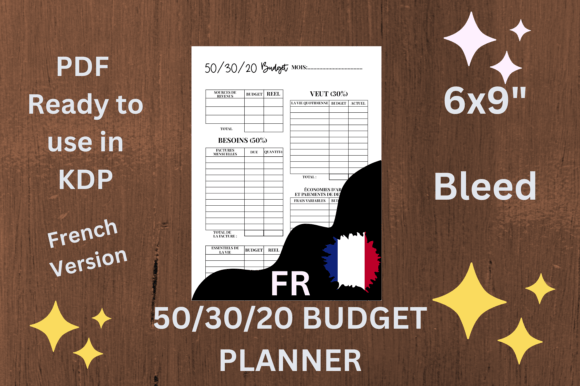
Many budget planners follow the 50-30-20 rule conceptually, but few are structured for bilingual fluency *and* professional printing readiness. The French 50-30-20 Budget Planner KDP Ready includes fully translated sections—“besoins,” “envies,” and “épargne/remboursement”—with terminology consistent with everyday French financial discourse in France and Francophone Canada. More importantly, it’s engineered for real-world output: each page includes a 3 mm bleed area and is set at 300 DPI, meaning it prints cleanly without cropped edges or pixelation—critical if you’re printing physical copies or preparing a bound version for sale.
This differs from standard digital planners that prioritize screen use over print fidelity, or from free downloadable templates that lack KDP compatibility testing. While some Excel-based or Notion budget trackers offer flexibility and automation, they require setup, ongoing maintenance, and don’t provide the tactile, distraction-free experience of a guided PDF workbook. The French 50-30-20 Budget Planner KDP Ready bridges that gap: it’s static enough to use offline and structured enough to support disciplined tracking without technical overhead.
How It Compares With Other Budgeting Approaches
The 50-30-20 rule itself is a high-level allocation guideline—not a rigid formula. Its strength lies in simplicity and behavioral scaffolding. Compared to zero-based budgeting (where every euro is assigned a role) or envelope systems (which rely on physical or app-based segregation), the 50-30-20 method lowers entry barriers while still encouraging conscious trade-offs. The French 50-30-20 Budget Planner KDP Ready reinforces that balance: its minimalist design avoids overwhelming users with fields or calculations, yet provides dedicated space for income logging, category totals, savings goal setting, and debt repayment tracking—all in French.
For example, someone earning €2,800 net per month would allocate roughly €1,400 to needs (rent, utilities, groceries), €840 to wants (dining out, subscriptions, travel), and €560 to savings or debt. The planner structures those categories clearly—but doesn’t auto-calculate percentages. That’s intentional: it invites reflection, not passive input. In contrast, automated apps like YNAB or Spendee adjust allocations dynamically and sync across devices, but they often lack native French interfaces optimized for local tax or banking conventions—and they require subscription fees or data sharing.
Strengths and Realistic Tradeoffs
A key strength of the French 50-30-20 Budget Planner KDP Ready is its portability and privacy. As a downloadable PDF, it requires no login, no cloud storage, and no updates. You can fill it by hand, annotate digitally with Adobe Acrobat or GoodNotes, or even print and bind it into a notebook. That makes it especially useful for educators teaching financial literacy in French-language settings, coaches supporting clients with limited tech access, or expats adjusting to cost-of-living differences in French-speaking regions.
However, it does have limitations. It doesn’t track recurring transactions, generate reports, or flag overspending in real time. If your income fluctuates significantly month to month—or if you manage multiple currencies, complex investments, or business expenses—the planner’s fixed structure may feel too broad. Similarly, while the KDP-ready format is ideal for creators planning to sell printed versions on Amazon, it’s over-engineered for someone who only needs a quick, disposable tracker. In those cases, a simple spreadsheet or free printable might suffice.
When This Planner Fits—and When It Doesn’t
The French 50-30-20 Budget Planner KDP Ready is most effective for users who value clarity over complexity and consistency over customization. It suits:
- Beginners learning budgeting fundamentals in French, especially those unfamiliar with English-language financial resources;
- Bilingual professionals managing dual-income households or cross-border finances;
- Coaches, teachers, or nonprofit workers distributing budgeting tools to French-speaking communities;
- Self-publishers building a niche library of practical French-language productivity resources.
It’s less suited for users who need dynamic forecasting, multi-account reconciliation, or integration with bank feeds. If you’re paying off high-interest debt and need amortization schedules, or if you’re saving for retirement with tax-advantaged accounts like a PER in France, you’ll likely pair this planner with additional tools—like a dedicated debt payoff calculator or a retirement simulator—rather than rely on it exclusively.
Practical Use Cases and Integration Tips
Consider how a freelance graphic designer based in Lyon might use this planner: she invoices in euros but occasionally receives payments in CAD. She uses the planner to assign her average monthly net income to the three buckets, then tracks actual spending manually—adjusting quarterly when seasonal income shifts. Because the PDF includes blank date headers and summary lines, she can compare trends across months without switching platforms.
Another example: a university student in Montreal uses the planner alongside a shared Google Sheet for rent and groceries. The PDF handles her personal discretionary spending and savings goals, while the shared sheet manages group logistics. This hybrid approach leverages the planner’s focus on individual accountability without sacrificing collaboration.
Importantly, the minimalist layout means it adapts well to different workflows. You can add stickers, highlight key figures, or paste in receipts. There’s no lock-in—unlike proprietary apps where migrating data is cumbersome. And because it’s KDP-tested, creators know exactly how margins, fonts, and color contrast will render in final print—avoiding common formatting pitfalls like cut-off text or blurry charts.
Making an Informed Choice
Choosing a budgeting tool isn’t about finding the “best” one—it’s about matching structure to your habits, language needs, and long-term goals. The French 50-30-20 Budget Planner KDP Ready excels where simplicity, linguistic accuracy, and print reliability matter most. It won’t replace comprehensive financial software, nor does it aim to. Instead, it offers a grounded, accessible starting point—one that respects the cognitive load of managing money in a second language while honoring the discipline the 50-30-20 rule encourages.
If you’re evaluating alternatives, ask yourself: Do I need real-time syncing—or do I prefer deliberate, manual review? Is French terminology used consistently in my daily financial interactions? Will I print this, share it, or publish it? Answering those honestly helps clarify whether this planner supports your process—or whether another format better aligns with your current stage, tools, and priorities.