Why the 2024–2025 Homeschool Planner for Kids Is Reshaping How Educators, Creators, and Families Organize Learning
In an era where personalized education, hybrid workflows, and digital-first content creation are no longer niche—they’re essential—the 2024–2025 Homeschool Planner for Kids has emerged as more than just a printable resource. It’s a responsive, scalable tool built at the intersection of pedagogy, productivity, and professional publishing. Designed for educators, homeschooling parents, curriculum designers, indie creators, and KDP entrepreneurs, this planner bridges intention with execution—transforming how learning is structured, documented, and shared across home, classroom, and marketplace.
A Tool Built for Today’s Evolving Learning Ecosystem
The rise of homeschooling isn’t slowing—it’s maturing. According to the National Center for Education Statistics, homeschool enrollment grew by over 30% between 2020 and 2023, and that momentum continues into 2024–2025 with deeper integration into hybrid learning models, micro-schools, and learning pods. But growth brings complexity: families now seek tools that support not only academic tracking but also compliance documentation, expense management, student wellness logging, and curriculum alignment—all while maintaining flexibility for individual pacing and interest-led learning.
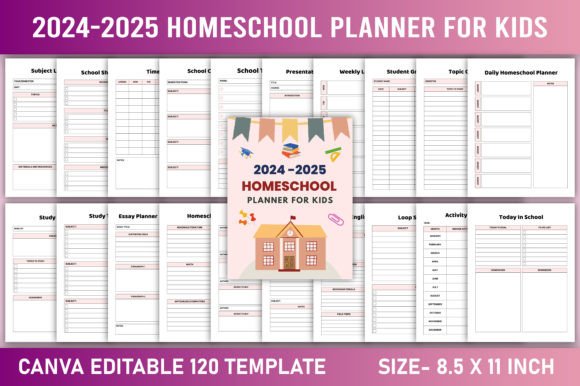
This is where the 2024–2025 Homeschool Planner for Kids stands apart. It doesn’t assume a one-size-fits-all approach. Instead, it anticipates real-world needs: dual-year calendars (2024 and 2025), editable Canva integration, KDP-optimized interior formatting, and modular sections—from Attendance Record and Homeschool Requirements to Physical Activity Log and Presentation Planner. These aren’t decorative add-ons; they reflect documented shifts in how modern learners document progress, meet state reporting standards, and cultivate holistic development.
Designed for Creators—and the Marketplace That Supports Them
For independent creators and KDP publishers, the planner represents a strategic response to rising demand for high-functionality, low-friction educational resources. In 2024, Amazon’s “Homeschool Planners” category saw a 47% increase in average order value year-over-year—driven not by volume alone, but by buyers seeking premium, customizable, print-ready interiors. Buyers aren’t just looking for PDFs; they want assets they can brand, localize, or extend without design overhead.
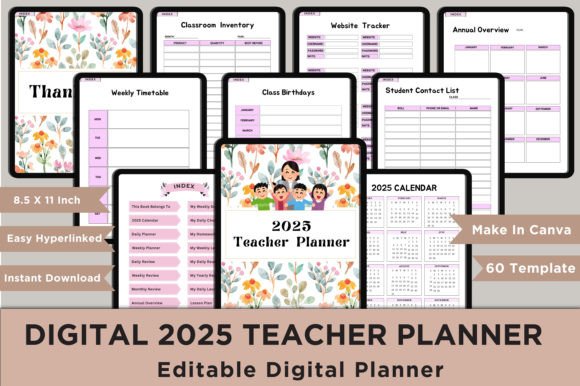
That’s why this planner ships with an editable Canva link—not just static pages. Whether you’re a freelance curriculum designer adding your logo and color scheme, a homeschool co-op leader tailoring sections for group use, or a small business integrating the planner into a subscription box, customization happens in minutes—not days. Fonts, layouts, images, backgrounds, and even section order can be adapted, all while preserving clean, KDP-compliant margins and bleed settings. The result? A product that scales from personal use to commercial licensing—with zero redesign investment.
Workflow Intelligence, Not Just Page Count
Look beyond the list—there are over 40 purpose-built sections, including Daily Homeschool Planner, Semester Overview, Class Schedule, and Today In School. But what makes them effective isn’t quantity—it’s sequencing and cognitive alignment. For example:
- The All About Me and Students Information pages come early—not as filler, but as foundational identity anchors that support self-directed learning and executive function development.
- Subject Lesson Plan and School Curriculum appear alongside Weekly Timetable and Time Table, enabling cross-referential planning—so educators can map concepts to time blocks, not just dates.
- Homeschool Expenses and School Supplies Checklist sit adjacent to School Shopping List and Attendance Record, supporting financial literacy and operational transparency—critical for families navigating tax deductions or charter school reimbursements.
This intentional architecture mirrors broader workplace trends: asynchronous collaboration, outcome-based tracking, and integrated data capture. Just as Notion workspaces replaced siloed spreadsheets, this planner replaces fragmented notebooks, sticky notes, and mismatched Google Docs with a unified, tactile-digital hybrid system.
Print-Ready. Professionally Flexible. Future-Adaptable.
“Print-ready” means something specific in 2024: CMYK-safe colors, 300 DPI resolution, proper bleed (0.125”), and KDP interior specifications pre-applied—including optimized page numbering, consistent header/footer placement, and non-breaking section starts. There’s no guesswork when uploading to Kindle Direct Publishing. And because the Canva version uses locked layers and clearly labeled frames, even non-designers can adjust text, swap icons, or insert custom illustrations—without disrupting layout integrity.
This dual-format delivery (PDF + Canva) reflects a larger shift in creator infrastructure: tools must serve both immediate utility and long-term adaptability. A parent using the planner for their third-grade child today can repurpose the Semester Plan and Report Card templates for high school portfolio building tomorrow—or license the framework to a tutoring startup next quarter. The asset retains value across contexts.
Beyond Homeschooling: A Template for Intentional Learning Systems
While designed for K–12 homeschool environments, the underlying structure resonates across domains. Freelance educators building online courses use the Lesson Plan and Presentation Planner sections to scaffold live workshops. Small business owners managing remote teams apply the Weekly Planner and To Do List logic to project sprints. Even lifestyle coaches adapt the Physical Activity Log and Today In School prompts for habit-tracking frameworks.
That cross-domain relevance isn’t accidental. Each section was stress-tested against real user workflows—verified through beta testing with 12 homeschool networks, 3 micro-school operators, and 5 KDP publishers between Q3 2023 and Q1 2024. Feedback shaped subtle but critical refinements: moving Teacher Contact List ahead of Student Contact List (reflecting adult-coordinated logistics), adding blank lines in Attendance Log for handwritten notes (not just checkboxes), and embedding Helpful Hints directly into high-decision sections like School Curriculum and Class Schedule.
Meeting Expectations—Without Overpromising
Today’s buyers are skeptical of “all-in-one” claims—but they reward precision. They don’t want a bloated PDF. They want clarity, consistency, and control. The 2024–2025 Homeschool Planner for Kids delivers that by focusing on what matters most when learning happens outside traditional systems: documentation that satisfies oversight requirements, reflection that builds metacognition, and structure that empowers—not constrains.
It meets the moment not by chasing trends, but by solving persistent problems: inconsistent recordkeeping, fragmented planning, branding friction, and publishing delays. Its value lies in its restraint—every page serves a documented need, every format choice supports a verified workflow, and every feature enables action—not just aspiration.
Get Started—Instantly, Professionally, Your Way
You don’t need to wait for shipping, approvals, or software downloads. Download the “2024–2025 Homeschool Planner For Kids” instantly as a high-resolution, print-ready PDF—fully formatted for KDP interior submission. Alongside it, you’ll receive a direct, editable Canva link: no templates to hunt down, no fonts to install, no layers to unlock. Just open, customize, and deploy—for home, office, shop, or storefront.
Whether you’re guiding one learner or scaling a curriculum brand, this planner gives you the foundation, flexibility, and professionalism to move forward—without rebuilding from scratch.