2025 Mindfulness Journal for Kids Canva
Helping children build emotional awareness, self-regulation, and joyful presence doesn’t require complex tools—just consistency, compassion, and the right support. The 2025 Mindfulness Journal for Kids Canva is a thoughtfully designed, fully editable digital resource that bridges developmental psychology with creative flexibility. Built for caregivers, educators, therapists, and homeschooling families, it transforms abstract mindfulness concepts into tangible, age-appropriate daily practices—all within a vibrant, printable 8.5×11-inch format.
Why Mindfulness Matters for Children in 2025
Today’s kids navigate fast-paced digital environments, academic pressure, and shifting social dynamics earlier than ever. Research continues to affirm that early mindfulness practice strengthens attention span, reduces anxiety, improves empathy, and supports executive functioning. Unlike adult journals, the 2025 Mindfulness Journal for Kids Canva meets children where they are: through sensory engagement, gentle reflection, and playful structure—not rigid discipline.
This isn’t about silent meditation at a desk. It’s about noticing the crunch of autumn leaves, naming feelings without judgment, drawing what “calm” looks like, or writing one thing that made them giggle today. Each page invites curiosity—not perfection.
What Makes This Journal Unique?
The Editable 2025 Mindfulness Journal For Kids Canva Template stands apart because it combines pedagogical intention with real-world adaptability. Here’s how:
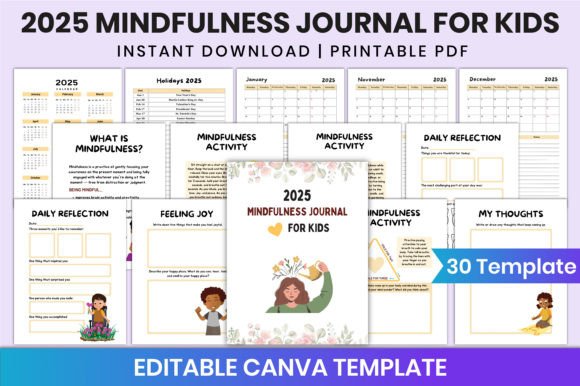
- Calendar-Integrated Design: Includes full-year 2025 calendar pages with U.S. federal holidays pre-marked—ideal for planning mindful moments around seasonal transitions (e.g., gratitude trees in November, breath-work prompts before winter break).
- Twelve Monthly Planners (Jan–Dec): Each month features a dedicated space for goal-setting, habit tracking, and reflection—designed with large fonts, intuitive icons, and room for doodling or stickers.
- Five-Senses Grounding Framework: A recurring section titled “Tuning In With Your Five Senses” encourages children to pause and observe: What do I hear right now? What texture feels comforting? What scent brings me back? This builds interoceptive awareness—the foundation of emotional literacy.
- Three Targeted Emotional Exploration Pages: “My Thoughts,” “Feeling Joy,” and “Coping With Anger” guide kids to name, validate, and respond—not suppress—their inner experiences. No jargon. Just open-ended prompts like “Draw your anger as a weather pattern” or “What helps my body feel safe when I’m worried?”
- Daily Reflection & Notes System: Two distinct reflection formats—one visual (emoji-based mood tracker + one-sentence summary), one narrative (“My Notes”)—support varied learning styles and evolving literacy levels.
Designed for Real Life—Not Just Theory
Whether you're a teacher introducing SEL (Social-Emotional Learning) in a 3rd-grade classroom, a therapist supporting neurodivergent clients, or a parent navigating bedtime resistance, this journal adapts. Its strength lies in its editability. Using the included Editable Canva Link, you can:
- Swap text to match your child’s reading level—or add bilingual labels (e.g., Spanish/English emotion words)
- Adjust font size for dyslexic-friendly readability or visual processing needs
- Change colors to align with school branding, therapy themes (blue for calm, green for growth), or sensory preferences
- Reorder pages to fit weekly lesson plans or individual therapy goals
- Add custom illustrations, photo placeholders, or QR codes linking to guided breathing audio
No design skills needed. Canva’s drag-and-drop interface works seamlessly on desktop or tablet—even offline after initial load.
Practical Use Cases You’ll Recognize
In the Classroom: A 4th-grade teacher uses the “Feeling Joy” page every Friday as part of circle time. Students share one joyful moment from the week—and illustrate it using the journal’s built-in sketch zone. Over time, students begin recognizing joy in small, ordinary things: sharing crayons, sunlight on the floor, finishing a puzzle.
In Therapy Sessions: A child psychologist prints the “Coping With Anger” spread and laminates it. During sessions, they co-create personalized strategies—like “squeeze this stress ball three times” or “say ‘I need space’ and walk to the blue chair.” The physical journal becomes a portable toolkit.
At Home: A busy working parent sets aside 7 minutes each evening for “Daily Reflection.” They sit side-by-side with their 7-year-old, asking gentle questions while the child draws or writes in “My Notes.” It’s not about fixing anything—it’s about showing up, together.
What’s Included—And Why It Matters
The package delivers more than convenience—it delivers reliability and readiness:
- 30 Canva Templates: Not just variations of one layout—each serves a unique purpose (e.g., “My Worries” includes tear-off worry cards; “Monthly Planner” has habit streak trackers).
- High-Quality Print-Ready PDFs: CMYK color mode, 300 DPI resolution, no bleed—ensuring crisp, professional results whether printed at home, school, or a local print shop.
- 100% Original Design: No stock clipart or generic layouts. Every icon, border, and illustration was crafted with developmental appropriateness in mind—soft edges, balanced whitespace, inclusive representation.
- 8.5×11 Inches Standard Size: Fits binders, folders, and most home printers—no scaling or cropping required.
Realistic Expectations—No Hype, Just Help
This journal won’t “fix” big challenges overnight—and it’s not meant to. Its value emerges over consistent, low-pressure use. Some children may fill pages daily; others might return to the same “Feeling Joy” spread for weeks, adding new details each time. That’s progress.
Limitations? It’s digital-first—so access to a device and basic Canva familiarity is needed for customization. While PDFs are ready-to-print, heavy editing (e.g., adding animations or interactive fields) isn’t supported. And though it’s inclusive by design, always pair it with relational warmth—no tool replaces attuned listening.
Who Benefits Most?
✔️ Educators seeking SEL-aligned, no-prep resources for grades K–5
✔️ Mental health professionals looking for concrete, reproducible handouts
✔️ Parents wanting screen-free emotional tools for home routines
✔️ Homeschoolers building personalized wellness curricula
✔️ Gift-givers seeking meaningful, non-toy presents for birthdays or holidays
Getting Started Is Simple
Once you receive your Editable Canva Link, you’ll land directly in a branded workspace—no sign-up or download required (unless you choose to save locally). Preview all 30 templates. Duplicate any page to experiment. Change a font. Adjust spacing. Swap a color palette. When ready, download as PDF or print instantly.
And because childhood development isn’t static, updates are part of the experience: following the creator ensures timely additions—like seasonal mindfulness prompts, neurodiversity-informed adaptations, or companion audio guides.
A Final Thought
Mindfulness for kids isn’t about stillness—it’s about connection. Connection to breath, to body, to feeling, to others. The 2025 Mindfulness Journal for Kids Canva doesn’t ask children to be different. It gives them language, space, and permission to be exactly who they are—while gently growing their capacity to notice, choose, and care.
That kind of quiet strength? It begins on a page—with crayons, curiosity, and one thoughtful prompt at a time.